Some links on this page are affiliate links. If you book through them, we may earn a commission at no extra cost to you. How we work
- A few hours to yourselves in Tokyo, with a cultural activity for the kids? HARAJUKU KIDS CLUB TOKYO offers 2- to 8-hour drop-off sessions for children aged 16 months to 10 years, with calligraphy, origami and crafts and English-speaking staff.
- An evening out while the kids stay at the hotel? Five sitter services and platforms are compared below. Babysitters & Company says all its sitters are fluent in English.
- A week or more of local preschool life? Japan Preschool Exchange places children aged 0–6 in a local preschool, mostly outside the big cities and mostly in Japanese. Most plans include accommodation, but some are childcare-only, so check what each plan includes.
Family travel in Japan is wonderful, and it’s also nonstop. Somewhere around day five, you might want a long lunch, an hour in a shop without a stroller, or just a quiet coffee. Meanwhile, your kids could be folding their first origami crane or writing their name with a brush.
Time for yourselves is a perfectly good trip goal, and it can come with something good for your kids too. Below are three ways to make it happen, by what you want from the day.
How we wrote this. We’ve used HARAJUKU KIDS CLUB TOKYO, Babysitters & Company, CareFinder, Poppins Nanny, Simplee, Babysits and Japan Preschool Exchange ourselves. Where we share our own experience, it’s labelled “From our own use.” Everything else (prices, ages, rules) comes from each official website and is labelled or noted as such. Prices and rules change, so confirm with the provider before you book.
Choose by what you want
| What you want | Look at | Can parents leave? |
|---|---|---|
| A cultural activity for the kids while you explore Tokyo | Culture kids’ club in Harajuku | Yes, drop-off and pick-up |
| A few hours of adult time (evening, dinner, shopping) | Hotel-visiting sitters | Yes, the sitter stays with your kids at your hotel |
| Living in one town and joining daily preschool life | Preschool exchange | Yes, during preschool hours |
A child who warms up slowly may do better with a sitter in a familiar hotel room than with a session somewhere new. That’s our suggestion, not a rule.
A culture kids’ club in Harajuku
Who it suits: families in Tokyo with children aged 16 months to 10 years who’d like a few hours to themselves, and kids who enjoy making things. You drop the kids off, spend the time around Harajuku, Omotesando or Shibuya, and pick them up afterwards.
What the kids do (official page): Japanese calligraphy (shodo), hiragana name practice, origami and Japanese crafts in all plans; yukata dress-up in the 2-hour example; and crêpe-making in the 5- and 8-hour plans (for ages 2 and up). The club says it is “Supported by Bilingual staff and English-speaking staff.”
From our own use: we booked the 4-hour Half Day plan for our 3-year-old. The staff ran activities built around Japanese culture, and everything was in English, which is rare for childcare in Japan. It was a really good experience.
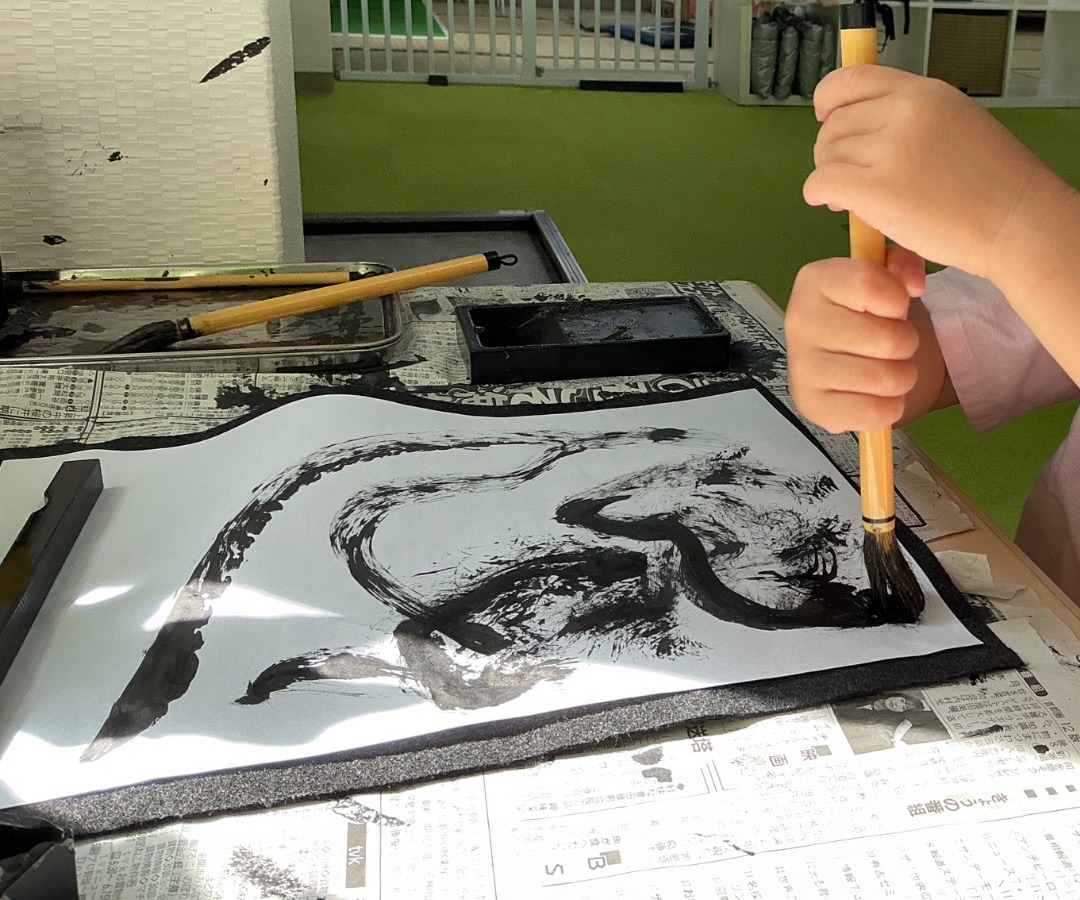
Ages, hours and cost (official page): 16 months to 10 years. Drop-off between 9:00 a.m. and 3:00 p.m., pick-up between 11:00 a.m. and 6:00 p.m. Plans run from ¥10,000 for 2 hours to ¥34,000 for 8 hours per child.
Plans, prices and care details (official page)
| Plan (official name) | Length | Price per child | Lunch |
|---|---|---|---|
| Short Stay | 2 hours | ¥10,000 | Not included |
| Half Day | 4 hours | ¥18,400 | +$6 (approx.) |
| Premium Full Day | 5 hours | ¥23,000 | +$6 (approx.) |
| Premium Full Day | 8 hours | ¥34,000 | +$6 (approx.) |
- The price table says “per person price” and shows approximate USD. It doesn’t say whether prices include tax. Snacks are included.
- Naps are available (“we check and document their breathing every 5 minutes”). Diapers, a daily report and photo updates via WhatsApp are provided. Bring a water bottle, a full change of clothes and a bag.
- The tourist page says the facility “is registered with the Tokyo Metropolitan Government,” without naming a facility category. Ask if that matters to you.
- A “Meet Local Japanese Kids” event runs on set days, but “participation by Japanese children may vary depending on attendance and scheduling.”
- Official site: send a request with your dates and drop-off/pick-up times. The club replies with availability, you pay online by card, and only then is the booking confirmed. “Cancellations made within 7 days of the booking date are non-refundable.”
- Klook: the club is also listed on Klook as a 2- to 8-hour drop-off for ages “1.4 to 10.” We couldn’t load Klook’s package prices or cancellation terms, so compare them with the official prices above before you book; they may differ.
Babysitters who come to your hotel
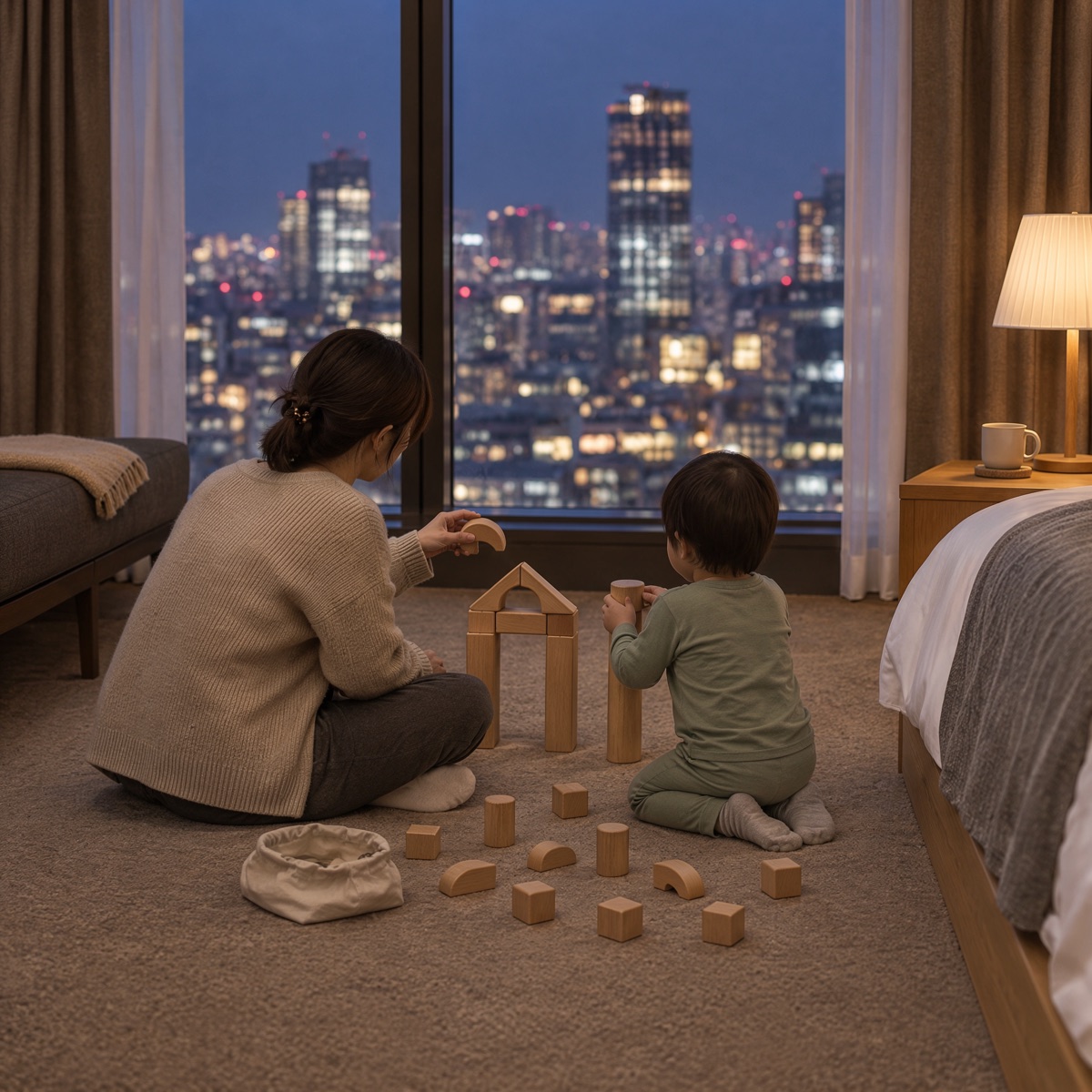
Who it suits: parents who want an evening out, a long dinner or a few errands, and children who are happiest in a familiar room (or are already asleep). A sitter comes to your hotel and you head out.
There are two kinds: agencies that choose and send a sitter (Babysitters & Company, Poppins Nanny, Simplee), and matching platforms where you choose a sitter yourself (CareFinder, Babysits).
From our own use: we’ve used all five services below. The table and notes are from each official website.
| Service | Area & English | Minimum & cost | How to book |
|---|---|---|---|
| Babysitters & Company | Hotels and Airbnbs across Japan, mainly Tokyo, Yokohama, Nagoya, Kyoto, Osaka. “All of our babysitters are fluent in English.” | 3 hours. ¥3,500/hour before tax, plus surcharges and the sitter’s train fare | Enquiry form, then quote and invoice |
| CareFinder | Hotels and Airbnbs across Tokyo. English-speaking sitters | Not stated. Sitter’s own rate (typically ¥2,500–5,000/hour for travel bookings) + platform fee + transport | Post your dates and hotel area; sitters apply |
| Poppins Nanny | Through the concierge at partner hotels (not named). English-speaking nannies “upon request” | Not stated. Pricing from the hotel | Your hotel’s concierge |
| Simplee | Your hotel room; areas and English not stated on its (Japanese) hotel page | 2 hours. ¥4,400/hour (9:00–21:00) or ¥5,500/hour (21:00–9:00), tax included, plus transport | Online form or LINE |
| Babysits | Platform covering 24 cities incl. Tokyo, Osaka, Kyoto, Fukuoka, Sapporo. Check each profile for English; hotel visits not mentioned | Not stated. Booking fee 15% (free plan) or 3% (Premium) | Message a sitter, then book on the platform |
"Not stated" means we couldn't find it on the official pages we read, not that there's no rule. Whatever you pick, tell your hotel in advance that an outside sitter will come to your room.
Fees, cancellation and checks for each service (official pages)
Babysitters & Company. Sitters “undergo police checks and reference checks,” and liability insurance is included. On top of ¥3,500/hour (before tax): +¥250/hour on weekends, holidays and listed high seasons (Dec 19–Jan 11, Apr 29–May 9, Aug 7–15 for 2026–27), +¥500/hour from 22:00 to 8:00, and +25% per extra child. Pay in advance by card; train fare in cash. Cancellation: full refund 48+ hours ahead, 50% at 24–48 hours, none within 24 hours. Overnight care “available upon request.” No age range stated.
CareFinder. A matching platform. Sitters are interviewed and insured (“Sompo Japan liability insurance up to ¥500 million”), and “Childcare providers are properly filed with local authorities.” Platform fee 22% per booking on the free plan, or 11% on a ¥3,278/month plan (tax included). Minimum hours and cancellation rules weren’t on the pages we could read.
Poppins Nanny. Covers ages “from newborns through 18 years old” and accepts same-day requests “subject to availability.” Pricing and booking go through the hotel; ask your concierge whether it’s offered where you’re staying.
Simplee. Staff hold national qualifications such as nursery teacher or nurse. ¥3,000 deposit when a sitter is confirmed, the rest afterwards. Same-day bookings cost 1.5 times the usual rate; age limits “vary” by service and area.
Babysits. “All members complete mandatory ID verification before messaging”; reviews, ratings after every booking and an optional criminal-record certificate. Free members can’t start a conversation; Premium (from ¥830/month on a yearly plan, ¥2,490 month to month) can. You can “cancel up to 60 minutes after the start time for a full refund.” Sitters’ hourly rates aren’t stated on the pricing page.
Ask Babysitters & Company for a quote
See CareFinder’s hotel sitter page
Preschool exchange stays
Who it suits: families with children up to 6 who want to slow down in one town for a week or more, often in the countryside, and kids who are fine with a day that runs in Japanese. Weekdays follow a routine: preschool drop-off, your own time until pick-up, family days at weekends.
What the kids do (official pages): they join a regular class at a local preschool (hoikuen ryugaku, “nursery-school study abroad”). The FAQ says the program “welcomes participants who do not speak Japanese,” but “the language used is Japanese” and the staff and children are Japanese. A few destinations, such as Ueda International School (Nagano), describe an “English friendly” environment.
From our own use: we’ve used Japan Preschool Exchange.
Ages, hours and cost (official pages): the program is for children “from 0 to 6 years old,” and each preschool sets its own range and hours (the listings we read ran from 9:30–14:00 to 8:30–16:30). Plans are weekly, weekdays only; preschools close on Japanese national holidays with no reduction in fees.
Accommodation: check each plan. Most destinations we checked sell the preschool together with a place to stay (for example, a “6-Night Preschool Standard Plan” with a named house or apartment). But some booking calendars also list a “School Fee Only (No Accommodation)” plan, where you arrange your own stay: Kamidaki Preschool (Toyama) and Kushiro Shirakaba Preschool (Hokkaido) are two examples. The general FAQ still says the program is sold as a package with accommodation, so confirm with the operations desk which plans your destination offers, and read what each plan includes before comparing prices.
Prices and what's included (official pages)
- Accommodation plans: the plan page lists childcare, accommodation, household essentials and Wi-Fi as included; flights, local transport (including car rental), meals and the local accommodation tax are not.
- Average price (estimate, accommodation plans): 1 adult + 1 child, USD 3,080 for 1 week; 2 adults + 1 child, USD 3,270 for 1 week (USD 4,910 for 2 weeks). The page says prices “are estimates and may vary by destination and season” and doesn’t say whether they include tax.
- Childcare-only examples: Kushiro Shirakaba’s booking calendar shows a “5-Day Preschool No Accommodation Plan” at ¥295,200 (about US$1,862) with the default search of 2 adults and 1 child; the page doesn’t break down what that covers, so ask. Kamidaki’s “5-Day Preschool & Elementary No Accommodation Plan” showed every listed date as sold out.
- Getting around: depends on the destination. Some rural ones recommend a car; the booking site lets you filter for car-free options.
- Payment: taken by card on the check-in date. Cancellation fees follow a policy on the booking site.
Browse Japan Preschool Exchange destinations
Can my kids attend a regular Japanese school?
Usually not on a holiday. Public kindergartens and schools are run by each city for children who live there. In Shibuya, for example, ward kindergartens ask that children “live in the ward,” and the short-stay route into public elementary and junior high schools asks for at least 4 weeks of attendance, an understanding of Japanese, and a home in the ward (“hotels” are not accepted). If you’re planning a longer stay in an apartment, ask that city’s board of education (kyoiku iinkai). (Shibuya City, in Japanese)
Before you book: what to check
Ask the same questions whichever option you choose:
| Check | What to ask |
|---|---|
| Age & language | Does my child’s age fit? What language do staff use with the children? |
| Settling in | What happens if my child is upset at drop-off? |
| Meals, allergies & naps | Is food included? How are allergies handled? Is there a nap time? |
| Drop-off & pick-up | Exact times, place, and who may collect the child? |
| Total cost | Tax included? Minimum time? Extra fees (night, extra child, transport, lunch)? |
| Cancellation | Until when can I cancel or change dates, and what do I pay? |
| Emergency contact | Who calls whom, and which clinic or hospital is used? |
Email-ready questions in Japanese
| English | Japanese |
|---|---|
| Does the sitter speak English? | シッターの方は英語を話せますか? |
| Have you filed as a babysitting business with the prefecture? | 都道府県にベビーシッター事業の届出をしていますか? |
| Can the sitter show a nursery teacher or babysitter certificate? | 保育士証または認定ベビーシッターの資格証を見せていただけますか? |
| What insurance do you have, and how much does it cover? | どのような保険に加入していますか?補償額はいくらですか? |
| Is the price tax-included? Are there any extra fees? | 料金は税込ですか?追加料金はありますか? |
| Can an outside babysitter come to our room? (to the hotel) | 外部のベビーシッターに客室へ来てもらってもよいですか? |
What the Japanese government says to check
Japan’s Children and Families Agency (こども家庭庁, the national ministry for children) publishes “Points to note when using babysitters.” Here is a plain-English summary of its 10 points. (Children and Families Agency, in Japanese)
| # | The government’s point | What it means for a visiting family |
|---|---|---|
| 1 | Gather information | Choose on trust, not on price. For matching platforms, it points to a site that checks platforms against national guidelines. |
| 2 | Meet beforehand | Meet the sitter, and hand your child only to the person you met. A video call is the practical version from abroad. |
| 3 | Check name, address and contact | Ask for ID, and whether the business has filed with the prefecture. |
| 4 | Check the place of care | If care isn’t in your room, see the place first. |
| 5 | Check qualifications | Ask to see a nursery teacher (hoikushi) card or a certified babysitter card. |
| 6 | Check insurance | Ask what it covers and up to what amount. |
| 7 | Check in while you’re out | Message or call to ask how your child is doing. |
| 8 | Plan for emergencies | Make sure you can be reached at once if your child gets sick. |
| 9 | Hear how it went | Ask for a report when you come back. |
| 10 | Speak up | Raise problems with the provider, and if needed the local government or a consumer center. |
About filing (“todokede”). Under Japanese law, a business that cares for even one child in a day must file a notification with the prefecture (or a large city). It’s a notification, not a license or a quality rating, so it’s one check among the ten, not a guarantee. Tokyo publishes a list of babysitting businesses that have filed with it (in Japanese); businesses based in some wards, such as Minato, Shinagawa and Setagaya, are on those wards’ own lists instead. (Tokyo Metropolitan Government, in Japanese)
Booking a sitter or a kids’ club works best when the rest of the trip has room to breathe. Our own printable, Japan’s Secret Rules for Kids + Family Trip Planner, helps you plan that: pacing by age, an energy-based day planner, rainy- and rest-day swaps, a book-ahead tracker, kids’ fares and IC cards, hotel booking questions, an allergy card and parents’ phrase cards. For the kids, there’s Japan’s Secret Rulebook (24 cards, a quiz and a certificate), a travel journal and Japan bingo.
36 pages, A4 and US Letter PDFs, for families with children aged 0–12. $12, instant download.
Stay connected
You’ll be messaging the sitter or club and checking photo updates on the go. Mobal’s Japan Travel eSIM gives unlimited data for 3 to 31 days (from ¥1,650 for 3 days, tax included). It’s data only, so use messaging apps for calls.
FAQ
Have you used these services yourselves?
Yes: HARAJUKU KIDS CLUB TOKYO, Babysitters & Company, CareFinder, Poppins Nanny, Simplee, Babysits and Japan Preschool Exchange. We describe our experience only for the Harajuku club; for the rest, the details come from each official website.
Can I get English-speaking childcare in Japan?
Yes, mainly in the big cities. Babysitters & Company says all of its sitters are fluent in English, CareFinder lets you choose English-speaking sitters in Tokyo, and HARAJUKU KIDS CLUB TOKYO has bilingual and English-speaking staff. Preschool exchange destinations mostly run in Japanese.
Is it safe?
We can’t promise that any service is safe. Follow the government’s checklist above: meet the carer first, check ID, qualifications and insurance, ask whether the business has filed with the prefecture, and stay reachable while you’re out.
Sources
Some pages are in Japanese.
- HARAJUKU KIDS CLUB TOKYO — for tourists: https://harajuku-kids-club-tokyo.com/for-tourist/; booking request: https://harajuku-kids-club-tokyo.com/reservation/; Klook listing: https://www.klook.com/activity/190387-japanese-culture-daycare-experience-harajuku-kids-club-tokyo/
- Japan Preschool Exchange — home: https://preschool-exchange.com/; 1–3 week plan: https://preschool-exchange.com/plan/bLSuXN0s; FAQ: https://japan.preschool-exchange.com/faq/en; destinations: https://reserve.preschool-exchange.com/; booking calendars for Kamidaki Preschool: https://reserve.preschool-exchange.com/preschool/toyama/toyama/kamidaki/availability and Kushiro Shirakaba Preschool: https://reserve.preschool-exchange.com/preschool/hokkaido/kushiro/kushiroshirakaba/availability; Kushiro Shirakaba page: https://japan.preschool-exchange.com/kushiro-kushiroshirakaba/lp/en
- Babysitters & Company — home: https://babysitters.jp/en/; price: https://babysitters.jp/en/price; FAQ: https://babysitters.jp/en/faq
- CareFinder — home: https://www.carefinder.jp/en; hotel & travel babysitting: https://www.carefinder.jp/en/use-cases/hotel-travel-babysitting/
- Poppins — English home: https://www.poppins.co.jp/english/; Poppins Nanny: https://www.poppins.co.jp/english/nanny/
- Simplee — hotel childcare (Japanese): https://simplee.jp/hotel/ja
- Babysits — English home: https://en.babysits.jp/; pricing: https://en.babysits.jp/pricing/; trust & safety: https://en.babysits.jp/trust/
- Shibuya City — ward kindergartens: https://www.city.shibuya.tokyo.jp/shisetsu/hoikuen/yochien/kuritsu_yochien.html; elementary & junior high enrollment: https://www.city.shibuya.tokyo.jp/kodomo/gakko-kyoiku/nyugaku-tennyu-shugaku/tetsuduki_g.html
- Children and Families Agency, “Points to note when using babysitters”: https://www.cfa.go.jp/policies/hoiku/ninkagai/tsuuchi/babysitter
- Kanagawa Prefecture, same 10 points: https://www.pref.kanagawa.jp/docs/sy8/cnt/f533907/baby.html
- Tokyo Metropolitan Government, list of babysitting businesses that have filed: https://www.fukushi.metro.tokyo.lg.jp/kodomo/hoiku/ninkagai/ninkagai-ichiran/kyotaku_list
- Mobal — Japan Travel eSIM: https://www.mobal.com/esim-japan-travel/